
In clinical research and diagnostics, the most informative biomarkers are often present at vanishingly low concentrations. Conventional immunoassays such as standard ELISA frequently cannot measure them reliably, leaving a blind spot precisely where early, actionable information lives. Ultrasensitive immunoassays close that gap by detecting proteins down to the femtogram-per-millilitre range.
Why conventional immunoassays hit a wall
A traditional ELISA reports an average signal across an entire sample. As target concentrations fall, that averaged signal sinks into background noise, and the limit of detection is reached well before biologically relevant low levels are captured. For biomarkers that circulate at pg/mL or below — many cytokines, neurological and cardiac markers, or early tumour-associated proteins — this is a fundamental limitation, not a calibration issue.
From averaging to counting single molecules
The breakthrough that enabled ultra-high sensitivity was a change of paradigm: instead of measuring an average, count individual molecules one by one. When each captured target is resolved as a discrete, digital event, the measurement is no longer limited by ensemble noise, and the dynamic range extends several orders of magnitude lower.
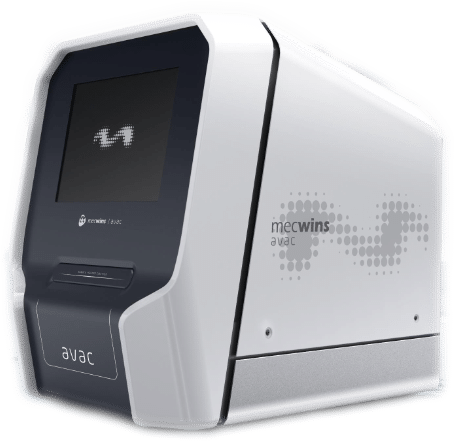
Mecwins' AVAC technology applies this principle optically. Target proteins are captured and labelled with plasmonic nanoparticles, and each nanoparticle is then detected and counted individually by dark-field micro-spectrophotometry. Because the readout is a direct, single-particle digital count, the AVAC Analyzer reaches sensitivities in the femtogram range while keeping a simple, robust workflow.
What ultra-sensitivity unlocks
- Earlier detection: biomarkers become measurable at concentrations that precede symptoms or conventional thresholds.
- Wider dynamic range: the same assay can follow a marker from baseline to elevated states without saturation.
- Less invasive sampling: reliable quantification in blood and plasma reduces the need for more invasive procedures.
Where it makes a difference
Ultrasensitive detection is transforming research across multiple fields — from oncology and cardiology to neurology, immunology and infectious disease. In each, the ability to quantify a protein that was previously below the limit of detection opens new windows for discovery and, ultimately, for clinical decision-making.
If you are evaluating ultrasensitive protein detection for your research or clinical programme, talk to the Mecwins team about how AVAC can fit your application.